
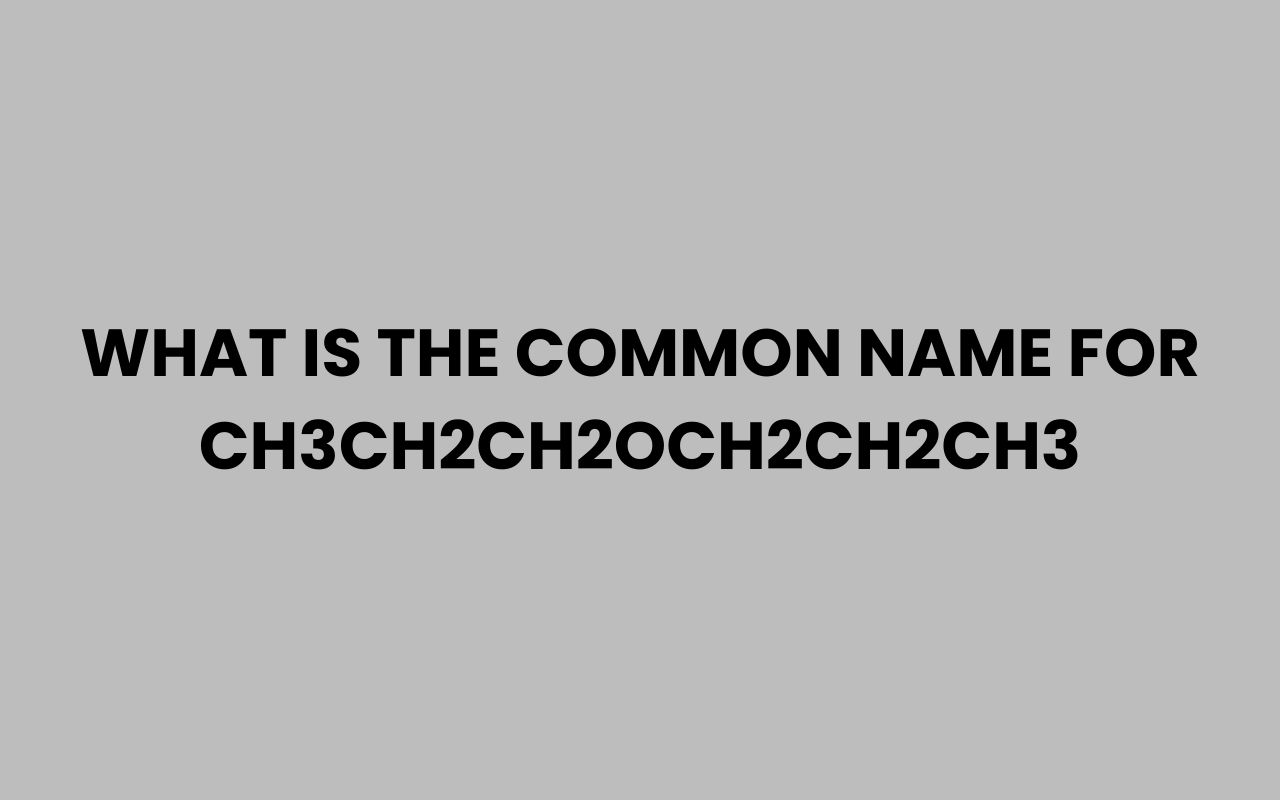
When encountering a chemical formula like CH3CH2CH2OCH2CH2CH3, many might feel overwhelmed or confused about what compound it represents. This formula is a fascinating example of how organic chemistry uses shorthand to describe complex molecules.
Understanding the common name behind this formula not only reveals the compound’s identity but also opens a window into its practical applications and relevance in daily life. The formula itself hints at a molecule with specific groups and connections, which can be decoded step-by-step to unveil its true nature.
In chemistry, the common name often differs from the systematic IUPAC name, providing an easier way to communicate about substances without the technical jargon. For CH3CH2CH2OCH2CH2CH3, knowing the common name helps bridge the gap between chemical structure and everyday references, whether in industrial usage, household products, or academic contexts.
This post explores the common name of this compound, breaking down its structure, properties, and significance. Alongside, we’ll examine related chemical terms, uses, and comparisons, enriching your understanding of this organic molecule beyond mere formula recognition.
Understanding the Molecular Structure of CH3CH2CH2OCH2CH2CH3
At first glance, the formula CH3CH2CH2OCH2CH2CH3 looks like a string of carbon and hydrogen atoms connected by an oxygen atom. This arrangement suggests a type of ether, an important class of organic compounds characterized by an oxygen atom bonded between two alkyl groups.
The molecule consists of two propyl groups (CH3CH2CH2-) connected by an oxygen atom (-O-). This indicates that the molecule is an ether derived from two propyl chains.
Breaking it down:
- CH3CH2CH2-: This is a propyl group, a three-carbon alkyl chain.
- O: The oxygen atom acts as a bridge.
- CH2CH2CH3: Another propyl group on the other side.
Therefore, the structure is propyl ether, where the oxygen atom links two propyl groups. This makes the molecule a symmetrical ether, distinguishing it from mixed or asymmetrical ethers.
“Ethers are vital in organic chemistry due to their stability and unique bonding, often serving as solvents or intermediates in synthesis.”
The Common Name: Di-n-propyl Ether
The formula CH3CH2CH2OCH2CH2CH3 corresponds to the compound commonly known as di-n-propyl ether. This name reflects the two identical propyl groups (n-propyl) connected via an ether linkage.
In organic nomenclature, “di-” denotes two identical substituents, “n-propyl” refers to the straight-chain propyl groups, and “ether” indicates the oxygen bridge. This common name is widely used in both academic and industrial contexts, as it conveys the molecule’s identity succinctly.
Di-n-propyl ether is part of a broader family of ethers, where the alkyl groups can vary in length and branching. The “n” prefix is crucial as it specifies the straight-chain form rather than branched isomers.
Understanding this common name helps distinguish it from other ethers, such as methyl ethyl ether or di-isopropyl ether, which have different alkyl groups and properties.
Comparing Di-n-propyl Ether to Other Ethers
| Compound | Formula | Common Name | Structure Type |
| CH3OCH3 | Dimethyl ether | Simple symmetrical ether | |
| CH3CH2OCH3 | Methyl ethyl ether | Asymmetrical ether | |
| CH3CH2CH2OCH2CH2CH3 | Di-n-propyl ether | Symmetrical ether with propyl groups | |
| (CH3)2CHOCH(CH3)2 | Di-isopropyl ether | Symmetrical branched ether |
Physical and Chemical Properties of Di-n-propyl Ether
Di-n-propyl ether exhibits a unique set of physical and chemical properties that make it useful in various applications. Its molecular weight and structure influence its boiling point, solubility, and reactivity.
Physically, di-n-propyl ether is a colorless liquid with a distinctive ether-like odor. It is less dense than water and exhibits moderate volatility.
Chemically, the ether group (R-O-R’) is relatively stable, making di-n-propyl ether resistant to strong acids and bases under normal conditions. However, it can undergo cleavage under acidic environments, a common reaction in ether chemistry.
- Boiling point: Approximately 90 °C, higher than dimethyl ether due to increased molecular weight.
- Solubility: Slightly soluble in water but miscible with organic solvents like ethanol and benzene.
- Flammability: Highly flammable, requiring careful handling.
These properties make di-n-propyl ether a candidate for use as a solvent in organic synthesis or as an intermediate in chemical manufacturing.
Applications and Uses of Di-n-propyl Ether
Di-n-propyl ether finds its place in various industrial and laboratory settings. Its chemical stability and solvent properties are key reasons for its utilization.
One common use is as a solvent in organic reactions where polar aprotic solvents are required. Its moderate polarity allows for dissolving a range of organic compounds without participating in unwanted side reactions.
Additionally, di-n-propyl ether serves as an intermediate in the synthesis of other chemicals, including pharmaceuticals and specialty chemicals. Its role as an ether compound also makes it relevant in studies of molecular interactions and physical chemistry.
- Solvent in organic synthesis
- Intermediate in pharmaceutical manufacturing
- Component in fuel additives due to its oxygen content
- Research reagent for studying ether properties
Despite its usefulness, safety precautions are necessary due to its flammability and potential health effects upon inhalation or skin contact.
Synthesis of Di-n-propyl Ether
Synthesizing di-n-propyl ether typically involves the reaction of alcohols under acidic conditions, a process known as Williamson ether synthesis or acid-catalyzed dehydration.
The most straightforward method is the dehydration of n-propanol, where two molecules join via an oxygen atom after the removal of water. This reaction requires an acid catalyst, often sulfuric acid, and controlled temperature to favor ether formation over alkenes.
The overall reaction can be summarized as:
- 2 CH3CH2CH2OH → CH3CH2CH2OCH2CH2CH3 + H2O
The process needs careful monitoring since competing reactions can reduce yield or create unwanted byproducts. Purification typically involves distillation to isolate the ether from the reactants and side products.
Alternative Synthesis Routes
Besides acid-catalyzed dehydration, Williamson ether synthesis provides another pathway. This method involves reacting an alkoxide ion with an alkyl halide:
- CH3CH2CH2ONa + CH3CH2CH2Br → CH3CH2CH2OCH2CH2CH3 + NaBr
This nucleophilic substitution reaction occurs under milder conditions and often yields higher purity products. Understanding these methods is essential for chemists aiming to produce di-n-propyl ether efficiently.
Safety and Handling Considerations
Working with di-n-propyl ether requires attention to safety due to its flammability and potential health hazards. Proper handling protocols minimize risks in lab and industrial environments.
The ether vapor can form explosive mixtures with air, so it should be used in well-ventilated areas away from ignition sources. Personal protective equipment (PPE) such as gloves and goggles is recommended to prevent skin and eye contact.
In case of spills, immediate cleanup using inert absorbents and proper disposal according to environmental regulations is crucial.
“Ethers, including di-n-propyl ether, have caused serious accidents historically due to peroxide formation and flammability, underscoring the importance of careful handling.”
- Store in cool, dry, and well-ventilated areas
- Avoid open flames and static electricity
- Use PPE when handling
- Dispose of waste properly
Familiarizing oneself with the material safety data sheet (MSDS) for di-n-propyl ether is a vital step before any usage.
Environmental Impact and Regulations
Like many organic solvents, di-n-propyl ether has environmental considerations that influence how it’s manufactured, stored, and disposed of. Its volatility and flammability raise concerns about air quality and fire hazards.
Regulatory bodies impose limits on emissions and workplace exposure to protect both the environment and human health. Waste containing di-n-propyl ether must be treated to prevent contamination of water supplies and soil.
Ongoing research aims to develop greener synthesis methods and safer disposal techniques to reduce the ecological footprint of ethers and related compounds.
| Aspect | Consideration | Regulatory Standard |
| Emissions | Volatile organic compounds (VOCs) release | EPA limits on VOCs in industrial air |
| Workplace Exposure | Inhalation risk and skin contact | OSHA permissible exposure limits (PEL) |
| Disposal | Chemical waste handling | Local hazardous waste regulations |
Exploring Related Chemical Names and Concepts
Understanding the common name of di-n-propyl ether naturally leads to exploring related ethers and naming conventions in organic chemistry. Naming molecules correctly is essential for clear communication and safe handling.
The difference between common and systematic names often confuses newcomers, but grasping these concepts enhances comprehension of chemical literature and product labels.
For example, while di-n-propyl ether is the common name, its systematic IUPAC name is propoxypropane. Both names describe the same compound but from different nomenclature perspectives.
- Common names are often simpler and historically derived.
- Systematic names follow strict rules to describe structure unambiguously.
- Knowing both is beneficial for understanding chemical databases and regulations.
This principle applies broadly, whether discussing ethers, alcohols, or other organic compounds, connecting to broader chemical literacy.
For further insights on naming and meanings, you might enjoy exploring What Are Good Character Names for Stories and Games, which provides a creative angle on naming conventions, albeit in a different context.
Conclusion
Decoding the formula CH3CH2CH2OCH2CH2CH3 leads us to the common name di-n-propyl ether, a symmetrical ether with two straight-chain propyl groups connected by an oxygen atom. This compound exemplifies the elegance of organic chemistry nomenclature, balancing structure and simplicity.
We’ve explored the molecular structure, synthesis routes, physical and chemical properties, and practical applications, alongside safety and environmental considerations. Understanding di-n-propyl ether enriches our grasp of ethers as a chemical family and their role in both industry and research.
As chemistry continues to intersect with everyday life, knowing the common names of compounds bridges the gap between complex molecular formulas and their tangible uses. This awareness empowers better communication, safer handling, and appreciation of the molecular world around us.
For those curious to delve deeper into the significance of names, whether chemical or otherwise, exploring related topics like Is There Power in the Name of Jesus? Discover Why or how to own a band name can provide fascinating perspectives on the power and meaning embedded in names across various domains.
